FEB 2, 2020
With the worldwide panic of a new coronavirus outbreak in China, it is important to know at least the basics of what we are dealing with. In general, a coronavirus is a virus that causes respiratory illness and is named for its crown-like spikes (Boseley, Devlin, Belam, n.p.). These viruses all originate in bats and although the mode of transmission for this specific coronavirus is not known, it is believed to be spread similar to SARS (another coronavirus) through direct contact via droplets or indirect contact via fomites. The source of the novel virus is thought to be a seafood market in Wuhan, China, as many of those infected either worked or shopped there (CDC). With the virus having spread to the US and the Philippines, among other countries, it is important to take protective measures, especially by just washing your hands frequently, and avoid touching your eyes, nose, or mouth.
In order to protect yourself and your community, knowing what to look for is also important. The symptoms of this specific virus are: cough, fever, difficulty breathing, and very often, pneumonia. Of course, this does not mean that if you have a bad cough you have been infected with the coronavirus. Recent travel to China or interaction with someone who has, though, may be a sign that you should get checked by a physician. With not very much known about the new coronavirus, it is important to do your part in preventing transmission while scientists and doctors acquire more information about the novel virus.
In my own experience, I have seen many misrepresentations of the coronavirus, especially in social media. Because the virus originated in China, many people have taken it as an opportunity to be insensitive to cultural differences that may have contributed to the transmission of the virus to humans, specifically by mocking their local cuisine. This is most of the information that I have seen spread on sites like Twitter and Instagram, especially in the form of memes. This is the reason that I knew so little about the virus prior to this post. Despite the lack of information on social media, all major news sites, as well as the CDC and WHO are very good resources to stay updated with the worldwide condition of the virus.

FEB 9, 2020
After more lectures in MICRO, it has become increasingly easier to understand what I read about the Coronavirus. Mutations that cause antigenic drift is an especially important topic to understand when it comes to the virus, as mutations in its genome are likely responsible for the virus being able to infect humans. Why did this mutation occur? Well, the coronavirus is an RNA virus so it uses RNA dependent RNA polymerase (RDRP) to replicate its genetic information. RDRP, unlike the polymerase used to replicate DNA, has no proofreading mechanisms, so it results in frequent mutations, which can either be silent or can drastically change the phenotype of the virus. There is still a lot to learn about the coronavirus, and this is why everyone is so afraid of it.
Thankfully, the World Health Organization (WHO), will be convening a forum in Geneva from 2/11-2/12. Dr. Soumya Swaminathan, WHO Chief Scientist, states that the goal of the forum is to “[understand] the disease, its reservoirs, transmission and clinical severity and then develop effective countermeasures (WHO).” Using what we learned in MICRO, it is clear why these three things are important to consider. If the virus has several reservoirs, it could be transmitted by different hosts, and depending on what those are, we could see more widespread cases of the virus. Transmission, in my opinion, is the most important thing to consider, because if you can understand how it spreads, you can also establish effective preventative measures against it. Lastly, clinical severity must be considered so that we know how to deal with the virus once it has infected someone. Knowing what to expect in terms of how the virus progresses in the human body could be useful in decreasing fatality. Once more information is uncovered, we will be able to determine other important characteristics of the virus such as R0 (r naught) and dosage required for infection which all play a role in its spread.
The New York Times reports that a new study has revealed more information and really solidified how important it is to learn how the virus is spread. This especially alarming study reports that 41% of the first 138 patients diagnosed at Zhongnan Hospital of Wuhan University are thought to have contracted the virus while in the Zhongnan hospital (Grady, n.p.). In MICRO, we learned about Klebsiella pneumoniae being common in healthcare settings, as it can spread via respiratory devices like ventilators. So this makes me ask, is Coronavirus similar to K. pneumoniae? Is it capable of being spread via fomites? Several patients in the study were also admitted to the surgical department, as the symptoms they presented with were misleading, and this likely facilitated the spread of the virus.
With more research emerging on the 2019 nCoV, I hope that my next update can include more specific details on the virus, but until then remember…

MARCH 15 UPDATE
It’s been over a month since my last update on the 2019 Novel Coronavirus. Actually, wait, it’s called COVID-19 (Coronavirus diseases 2019) now, and man has it been causing some trouble. I am actually writing this update as a start to my SECOND week of spring break (pretty sure you’ve never heard of a 2 week spring break, neither have I). With the virus continuing to spread in the United States, most universities have chosen to close and move to online instruction and large events have been cancelled, including the NBA, NHL, NCAA, as well as concerts, music festivals, and even church services that see large crowds. These measures are all being taken to prevent the spread of COVID-19. Making matter worse, in my opinion, is the widespread panic that has led to grocery stores being cleared out, leaving several people without toilet paper, water, canned goods, and even diapers.
Just 4 days ago, the World Healthy Organization declared COVID-19 a pandemic, as we are seeing cases in the US, Italy, China, Japan, and several other countries. Focusing on Italy, many sacrifices are being made, as well, in an effort to save the country from the long term damage of COVID-19. Up until at least April 3rd, the Prime minister has decided to lock down the North region of the country, which poses a major threat, as the closure of cities like Milan and Venice could led to a short term collapse in their economies (New York Times, n.p.). As for the US, there are some predictions that as the virus continues to spread, similar measures to those taken in Italy may be necessary. The measures that are being taken support the wildfire-like spread of the virus, or exponential growth (which is what we should say as microbiologists). Simple measures such as washing your hands and “social distancing” are the two things that are being emphasized to stop the virus from reaching the level that it did in China, or even Italy.
Some things that we must consider as microbiologists in order to fully understand this virus as well is the fact that it can be spread without symptoms, it can be confused with the flu virus, and it has different effects depending on the host. Some people may be infected and spreading the virus without even knowing, which is how we are seeing hotspots for the disease. Scientifically speaking, it can spread so easily because it’s spike protein is activated by an enzyme called furin, which is found in our respiratory tracts, and explain how the virus is transmitted via inhalation of respiratory droplets (Mallapaty, n.p.). This enzyme is also found in the liver and small intestines, and it may have something to do with some of the effects seen in COVID-19, as well as the stability and transmission of the virus (Mallapaty, n.p.). Furin is also being investigated as a possible target of treatments for COVID-19, but further research on this is currently underway.
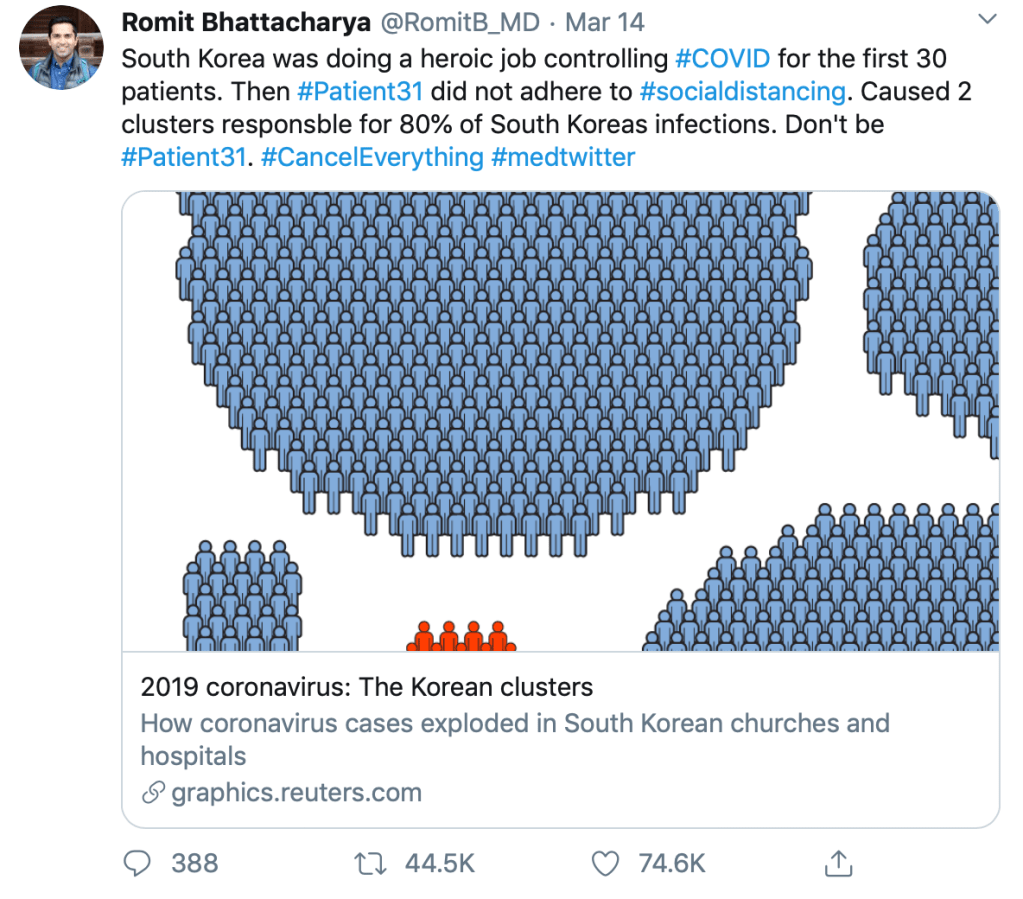
For the sake of graduation and global health, containing COVID-19 is the most important next step. This means, stay in your house if you do not absolutely need to go out, that means no bars and no parties (I know, it will be hard since we’re on “spring break”). If everyone assumes their individual role in surviving this epidemic then we may see a quicker recovery from the COVID-19 epidemic. Attached below is a tweet and article that you can read if you feel the need to leave your house and go about your day as normal.
4/5/2020 COVID-19 Update. Are we on the way to a vaccines and antivirals?
Well, one thing that has changed about COVID-19 is that the virus has officially been named SARS-CoV-2, as the second virus known to cause severe acute respiratory syndrome (SARS). As the number of cases continues to rise in the US and hospitals grow more and more overwhelmed with patients seeking testing and treatment, researchers are working hard to develop a preventative vaccine and/or treatment for the virus. There is bound to be some wait-time for these to be developed, as scientists must first gain a detailed understanding of the pathogenesis of the virus. Not only does SARS-CoV-2 share a name with 2003 SARS-CoV, but the two viruses are believed to share a receptor protein to which they attach, called ACE-2. Studying this protein could be effective against preventing COVID-19 since it offers a possible way to block the virus from entering its target cells.
This is exactly what is being done by an international team led by the University of British Columbia’s (UBC) Dr. Josef Penninger working to develop antivirals against COVID-19. They are focusing on ACE-2 and how they can use this receptor to lessen the viral load in severe cases. They have developed a drug called hrsACE2, or human recombinant soluble angiotensin-converting enzyme 2. Using stem cell-derived models of blood vessels and kidneys, which have both been shown as target cells of the virus, the team at UBC was able to show that SARS-CoV-2 infected these cells at a much lower rate when treated with hrsACE2 (ScienceDaily, n.p.) The mechanism of this drug is basically binding the virus before it can bind to actual ACE2 on target cells and infect them. The team is working on moving towards clinical trials soon, but the study is promising.
As for the vaccine, this is another important key to stopping the epidemic. Moderna, a biotechnology company based in Cambridge, and the National Institute of Health have partnered to find a COVID-19 vaccine and are currently underway with phase 1 human trials and on track to phase 2 around spring or early summer. Their trials are aimed at “hijacking” mRNA to carry a copy of the viruses genome and induce the production of antibodies against the virus (Harbert, n.p.) The company has no approved vaccine to date, but they had been working on a vaccine against MERS, another type of coronavirus, so they had a headstart to developing their vaccine, as MERS is genetically similar to SARS-CoV-2. Even if this sounds good, widespread distribution of the vaccine is still expected to come no sooner than September of 2020, which is why social distancing and taking individual precautions are so important right now during the height of the US pandemic.


 Jaylin’s Thoughts: Microbiology